
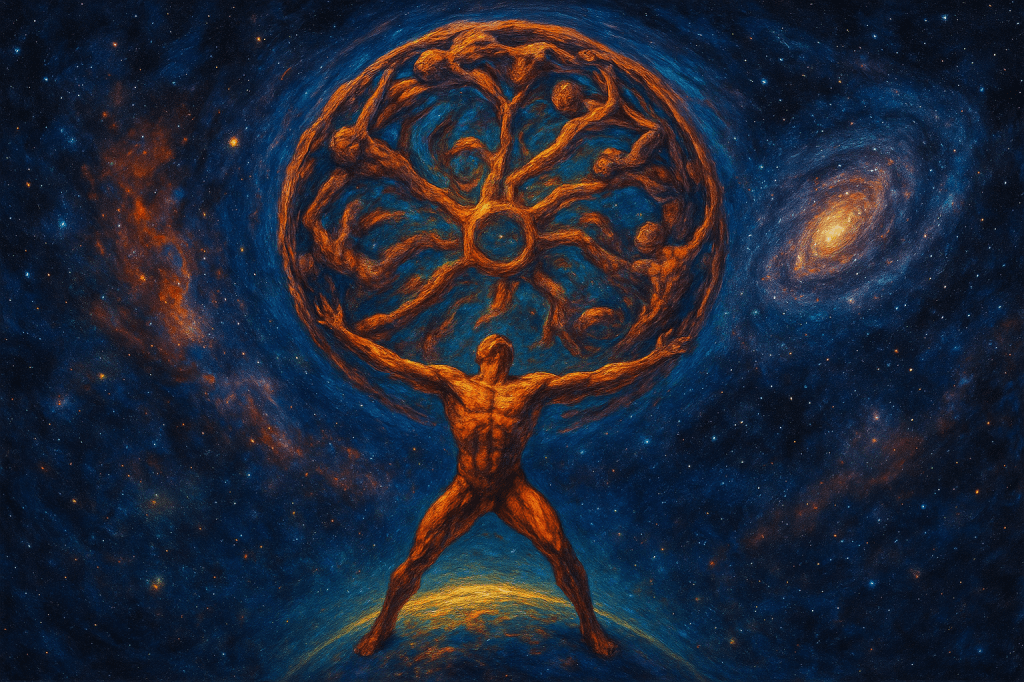
Sanātana Dharma is a vast ocean of philosophy, ethics, and spiritual practice that has been flowing for thousands of years. At its core lies the notion of conscious existence as an ongoing journey — a voyage of the soul across countless lifetimes, culminating in the ultimate goal of liberation from this journey.
This vision rests upon two intimately connected principles:
- Karma Cakra, the wheel of cause and effect that shapes our destiny
- Saṃsāra, the ceaseless cycle of birth and death
To truly grasp these ideas, one must turn to the deeper metaphysical ground on which they stand — the nature of the soul.
Core Metaphysical Concepts
Sanātana Dharma’s vision of existence rests on its postulation of the most fundamental cause of existence, or the ultimate reality of everything. Therefore, before exploring the mechanics of existence, it is important to understand the eternal relationship between three key metaphysical concepts:
- Brahman (the Ultimate Reality)
- Ātman (the innermost Self)
- Jīvātman (the individual soul bound in experience)
1. Brahman: The Infinite Reality
The Upaniṣad reveal the ultimate reality as the infinite, eternal field of consciousness that permeates and sustains the whole of existence. This purely spiritual singular field is called Brahman. From it arise all forms of matter and energy — every particle and wave, every microcosmic and macrocosmic entity of the universe.
Brahman is beyond time, beyond space, and beyond all limitations. Its true nature is expressed as Sat–Cit–Ānanda: pure existence, pure consciousness, and pure bliss. Out of reverence, this supreme reality is addressed as Parabrahma (Supreme Brahman).
2. Ātman: The True Self
Ātman is the essence of Brahman within each being. It is the unchanging True Self — the pure consciousness beyond body, mind, and personality, which witnesses every experience.
Ātman is not separate from Brahman. Just as a drop of water is, in essence, the same as the entire ocean, so is the core of our being identical to the infinite Brahman. Ātman is timeless, pure, and free — it is never born, and it never dies.
3. Jīvātman: The Individual Soul
The Jīvātman is the embodied Ātman. It is the ‘individualised aspect’ of the Self that experiences life through a particular body and mind.
Here is where the subtle distinction lies.
- The Ātman is unlimited — untouched by change, suffering, or bondage.
- The Jīvātman is limited — it carries the impressions of past actions and experiences (Saṃskāra).
A simple way to understand this is through an analogy. Imagine the sun shining brightly in the sky — this represents the Ātman, the pure Self. Now picture that same sunlight passing through a small, coloured window. The light appears tinted and shaped by the window’s frame, yet in truth the sunlight itself remains unchanged. In the same way, the Jīvātman is the Ātman seen through the ‘window’ of Saṃskāra.
Karma Cakra
The law of Karma refers to the ‘universal law of cause and effect’, which states that every action has a corresponding consequence, without exception.
Karma Cakra refers to the ‘wheel of cause and effect’, conveying the idea that our present circumstances arise from past deeds, while our current action choices shape the future. This is an ongoing cycle across time, shaping our destiny.
Karma — Action, Cakra — Wheel
In the Sanātana Dharma tradition, a soul’s Karma Cakra is believed to extend across lifetimes, perpetuating itself until one attains the insight to transcend and break free from limiting Kārmika patterns.
1. The Role Of Saṃskāra
Sanātana Dharma teaches that every thought, word, and deed leaves a subtle impression on our inner being. These impressions are called Saṃskāra.
Think of the psyche as soft clay: every action is like a fingertip pressing into it, leaving an impression. When the same response to a stimulus is repeated, the impression deepens. Over time, these accumulated marks shape the contours of our personality:
- Our natural tendencies
- Our instinctive likes and dislikes
- The choices we make
Since the choices we make result in the challenges and opportunities we encounter, Saṃskāra determine even the course of our destiny.
The relationship is like this:
- Karma creates Saṃskāra (psychological impressions).
- Saṃskāra influence future choices and behaviours.
- These choices produce more Karma, and the cycle continues.
Moreover, Saṃskāra attach themselves to the Ātman, carrying over from one life to the next, preserving individuality across lifetimes as the Jīvātman.
2. The Role Of Karma
Since every action leaves behind a Saṃskāra that carries forward into future lifetimes, the role of Karma extends beyond the immediate chain of events The consequences of Karma may not always appear right away; some unfold only in lives yet to come.
Sanātana Dharma classifies Karma into three broad categories:
- Sañcita Karma are the accumulated Saṃskāra created by Karma of all past lives, stored like seeds in the Jīvātman. Not all of it bears fruit at once.
- Prārabdha Karma are the portion of Sañcita Karma that has begun to fructify and has shaped our present life’s circumstances — our birth, family, body, and key events. Thus, Prārabdha Karma shapes our fate.
- Kriyamāṇa, or Āgāmi, Karma are the Saṃskāra we are creating right now through our current Karma — thoughts, words, and deeds. These will influence our future lives. Thus, Kriyamāṇa Karma shapes our destiny.
This framework explains why not everything in life can be traced to our current lifetime — many events are the ripening of ancient Kārmika seeds.
When the body dies, the Jīvātman departs, carrying its store of Saṃskāra, which become the seeds for the next life.
3. The Role Of Punarjanma
Punarjanma is the very process of reincarnation through which the soul continues its journey.
According to Sanātana Dharma, the Jīvātman does not perish with the body. Carrying all Saṃskāra, it seeks a new embodiment suitable for the next stage of its journey. This is called Punarjanma, or reincarnation. The process can be compared to a student moving from one grade to the next. You don’t start over from scratch; you continue from where you left off. Similarly, the Jīvātman’s new birth reflects the spiritual level, unresolved desires, and Kārmika debts carried forward.
This journey can take the soul through many forms of existence — human, animal, celestial, or even lower realms — depending on the dominant Saṃskāra produced by its Karma. Among these, human birth is considered the most precious, for it offers the unique opportunity to consciously strive for evolution and, ultimately, liberation.
Saṃsāra And Mokṣa
At first glance, Saṃsāra — the endless cycle of birth and death — might seem like a trap. But Sanātana Dharma presents it as a vast school for the soul’s spiritual evolution. Each lifetime is a classroom in which we learn the consequences of our actions, refine our understanding, and move closer to the realisation of our true nature.
1. Spiritual Evolution
The difference between Jīvātman and Ātman lies at the heart of spiritual evolution:
- Ātman is eternal and infinite. It is never born and never dies. It is pure (untouched by Karma) and free in its essence.
- Jīvātman is Ātman as experienced through the limitations of mind and body, bound by Karma and Saṃskāra, subject to pleasure and pain.
A metaphor often used is that of space:
- Space itself is infinite and unaffected by what happens within it (Ātman).
- But when you enclose part of that space in a jar, it appears limited (Jīvātman).
- When the jar breaks, the enclosed space is seen to be the same as the infinite space outside.
The spiritual journey is essentially the ‘breaking of the jar’ — the dissolution of Saṃskāra so that the Ātman shines through.
Over countless lifetimes:
- The Jīvātman matures spiritually.
- Saṃskāra of ignorance, selfishness, and attachment are gradually worn away.
- The light of the Ātman shines more clearly through the ‘window’ of the individual soul.
The ultimate graduation from the school of Saṃsāra is Mokṣa, or liberation from the illusion of separateness.
2. The End Of The Journey
When the Jīvātman, through lifetimes of purification and insight, dissolves the veil of ignorance, it recognises its own identity as the essence of Brahman, and no longer needs to be reborn. This is Mokṣa — freedom from the cycle of Saṃsāra.
In Mokṣa:
- The soul is no longer bound by Kārmika debts.
- The limited identity of the Jīvātman merges into the limitless reality of the Ātman.
- There is no more birth, no more death — only the bliss of pure being.
The Bhagavad Gītā captures this beautifully: “Just as a person puts on new garments, giving up old ones, so the embodied soul takes up new bodies, giving up the old and useless ones.” But when liberation is attained, the soul puts down the garments entirely, resting in its eternal, unchanging nature.
The Role Of Conscious Living
Understanding the Karma Cakra is not just an intellectual exercise — it profoundly influences how we live.
We begin to live with greater mindfulness, compassion, and purpose when we see that:
- Every action has lasting consequences.
- Our inner state shapes our future lives.
- The ultimate goal is to awaken from the illusion of separateness.
Conscious living in this context means:
- Acting with awareness of long-term consequences, not just short-term gains.
- Cultivating virtues like Satya (truthfulness), Ahiṃsā (non-violence), and Anukampā (compassion) to reduce negative Saṃskāra.
- Practicing goodwill and serving others selflessly, knowing that the same Ātman dwells in all.
- Purifying the mind through meditation, prayer, and self-inquiry.
Conclusion
Sanātana Dharma’s vision of Karma, Saṃskāra, Punarjanma, Saṃsāra, and Mokṣa offers not a fatalistic prison but a map of spiritual evolution.
We are not mere accidents of biology, nor helpless victims of fate. We are eternal beings — Ātman — currently journeying as Jīvātman, learning through the vast school of life. Our actions plant seeds that shape our destiny and our rebirths.
By understanding this cycle, we can live consciously, align our actions with higher truths, and gradually dissolve the ignorance that binds us. The final destination is the realisation that we were never truly bound at all — the Ātman was always free, infinite, and blissful.
Life, then, is not just about surviving; it is about awakening to the higher truth.
© Sujata Khanna. All rights reserved.
Sujata Khanna’s book, ‘The Eternal Law’, explores Sanātana Philosophy in its elemental form. Available on Amazon worldwide: India, USA, UK, Canada, Australia, Singapore, Germany, France, Spain, Italy, Netherland, Poland, Sweden, Japan
#SoulJourney #Mindfulness #Karma #KarmaChakra #SanatanaDharma #AncientWisdom #MustReadBook #TheEternalLaw

Leave a comment