
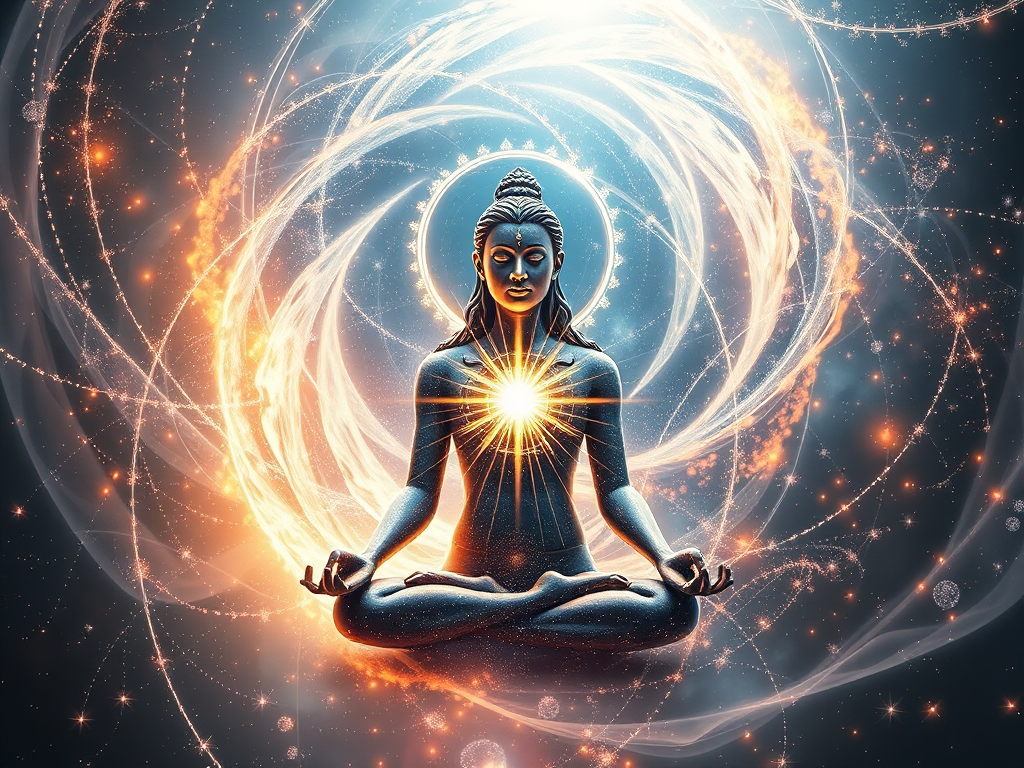
Sanātana Dharma is the ancient spiritual and philosophical tradition of India. Its core metaphysical insights resonate intriguingly with certain speculative interpretations of modern quantum physics. Though emerging from vastly different domains, both traditions gesture toward a vision of reality grounded in unity rather than fragmentation.
Monism is the philosophical view that there exists only one ultimate kind of reality or fundamental substance. All diversity in existence arises from this singular underlying principle.
- Spiritual Monism holds that all reality is one unified spiritual substance or consciousness, with the material world understood as a manifestation of this divine essence.
- Quantum Monism is a philosophical perspective inspired by quantum mechanics, suggesting that all particles, forces, and fields emerge from a single underlying quantum reality.
Though Spiritual Monism and Quantum Monism belong to different intellectual traditions — spiritual philosophy and modern physics respectively — both share the foundational intuition of an underlying unity beneath apparent multiplicity.
The Spiritual Monism Of Sanātana Dharma
In non-dual traditions of Sanātana Dharma, particularly as expressed in the Upaniṣad, the ultimate reality is identified as Brahman — Pure Consciousness itself. Brahman is described as:
- The infinite field of consciousness that both pervades and transcends the universe
- The singular spiritual substance from which all of creation proceeds
- The one reality underlying everything — from the smallest particles of matter and energy to complex conscious beings
In this sense, Brahman is a thoroughly monistic concept: all distinctions of form and name arise within one indivisible reality.
Philosophical Reasoning
To approach the idea of Brahman philosophically, it is useful to consider how science understands matter.
Perceivable matter is composed of increasingly fundamental building blocks:
- Material objects, living or non-living, are composed of molecules, the smallest units of matter that retain chemical identity. For example, H₂O is a water molecule.
- Molecules arise from combinations of elements such as carbon, oxygen, and iron.
- An atom is the smallest unit of an element that preserves its chemical properties.
- Atoms consist of protons, neutrons, and electrons. The variation in atomic structure gives rise to different elements, while their interactions — primarily through electron exchange or sharing — form molecules.
- Protons and neutrons themselves are composed of even smaller particles called quarks.
- According to current scientific understanding, quarks and leptons (such as electrons) are considered fundamental particles, meaning they are not known to be composed of anything smaller.
This raises deeper questions: Where do these fundamental particles come from? Is there a deeper layer beneath them? These questions remain open. As science advances, it may continue uncovering more fundamental descriptions of matter — but the inquiry itself suggests a limit.
This leads to the philosophical question of the First Cause.
- The ultimate cause must itself be causeless and eternal.
- Since all material entities appear to be contingent and caused, this ultimate reality must be non-material.
- Such a reality would therefore lie beyond direct empirical measurement.
Sanātana metaphysics answers this by positing existence as fundamentally unitary and spiritual. This one spiritual substance, termed Brahman, is the original cause and ultimate reality of the universe.
Brahman is described as eternal, infinite, omnipresent, omniscient, and omnipotent. It permeates every created form while simultaneously transcending the totality of creation. Thus, Sanātana philosophy emphasises deep interconnectedness and the ultimate unity of all existence.
Quantum Monism
Quantum Monism is a philosophical interpretation inspired by quantum mechanics, proposing that reality at its most fundamental level is an indivisible whole rather than a collection of independently existing parts. Certain features of quantum theory challenge classical notions of separateness and suggest a deeply interconnected universe.
- A quantum refers to the smallest discrete measurable unit of a physical quantity. For example, a photon is the quantum of light.
- Quantum mechanics is the branch of physics that studies matter and energy at the subatomic scale. Since all matter is ultimately composed of quantum entities, the physical universe can be said to exist within a quantum framework.
Interpretations of quantum theory play a significant role in the development of Quantum Monism, particularly through concepts such as quantum entanglement and theoretical frameworks like string theory.
1. Quantum Entanglement
Quantum entanglement is a phenomenon in which particles that have interacted become correlated in such a way that their properties remain linked, even when separated by vast distances. A change in the state of one particle is reflected in the other, regardless of spatial separation.
Einstein famously referred to this as “spooky action at a distance,” as it defies classical notions of locality and independence. While entanglement does not permit faster-than-light communication, it does reveal that entangled particles cannot be fully described as separate entities — they behave as parts of a single quantum system.
According to the Big Bang model, the universe originated from an extremely dense and unified state before expanding outward. Some physicists suggest that particles emerging from these early conditions may have been widely entangled, giving rise to a deeply interconnected quantum universe.
Although such entanglement is not directly observable at macroscopic scales, all particles may still participate in a vast network of indirect correlations. From this perspective, the universe can be viewed as a single, highly entangled quantum system.
Entanglement thus provides a modern scientific framework that supports the idea of an underlying quantum unity. Some philosophers and physicists interpret this as evidence for a universal quantum state — an idea closely aligned with Quantum Monism.
2. String Theory
Within the Standard Model of particle physics, matter is composed of fundamental particles such as quarks and leptons, while forces are mediated by particles like photons and gluons, along with the Higgs boson. These particles are considered fundamental in the sense that they are not composed of smaller constituents.
String theory is a leading theoretical framework that seeks to unify all fundamental forces and particles under a single description. It proposes that:
- Fundamental particles are not point-like objects but manifestations of tiny, vibrating strings of energy.
- These strings are the most basic entities, smaller than any known subatomic particle.
- Different modes of vibration of the same fundamental string give rise to different particles, much like different musical notes arise from a vibrating string.
- All strings are fundamentally identical; diversity arises from their vibrational patterns.
In this view, matter, energy, and even spacetime itself emerge from one underlying entity. While string theory remains mathematically sophisticated but experimentally unverified, it offers a compelling model in which reality is fundamentally unified.
This aligns closely with the core intuition of Quantum Monism: that multiplicity arises from a single foundational reality.
Conclusion
When modern scientific inquiry is placed in dialogue with Sanātana metaphysics, striking conceptual parallels emerge.
- Both, the concept of Brahman and Quantum Monism, point toward a fundamental unity underlying all existence.
- Brahman represents this unity in spiritual and metaphysical terms, while Quantum Monism approaches it through theoretical physics.
- In both perspectives, apparent separateness emerges from a deeper, indivisible reality. Diversity of form does not negate unity of essence.
The boundary between science and metaphysics may be more porous than traditionally assumed.
Rather than reducing one domain to the other, these intersections invite a more expansive understanding of reality — one that transcends strict materialism while remaining open to empirical inquiry. Together, science and spirituality may offer complementary pathways toward grasping the deeper unity of existence.
© Sujata Khanna. All rights reserved.
Sujata Khanna’s book, ‘The Eternal Law’, explores Sanātana Philosophy in its elemental form. Available on Amazon worldwide: India, USA, UK, Canada, Australia, Singapore, Germany, France, Spain, Italy, Netherland, Poland, Sweden, Japan
#Monism #QuantumMonism #Brahman #SanātanaDharma #AncientWisdom #TheEternalLaw #MustReadBook

Leave a comment